Okay, it’s time for the soundtrack to ‘Venetian Gothic’! Or, at least, for a playlist of the sort of music I was listening to whilst writing.
There are no real spoilers here. You could, if you so wish, match some of the music to scenes in the book – I certainly do – but it’s not essential, and we might not be thinking of the same scenes anyway.
We start, then, with Stelvio Cipriani, one of the great Italian soundtrack composers, and the theme music to the tough poliziottesco (*), La Polizia sta a guardare. It doesn’t, perhaps, have much (by which I mean ‘any’) relationship to either the book or Venice but it’s a cracker of a theme tune and it led me to investigate other work by Cipriani, an incredibly talented and versatile musician who worked in almost every genre you can imagine.
Next is Bruno Nicolai’s theme to the giallo (**) La dama rossa uccide sette volte. I put this one in because I like the clash of styles – the main theme, I think, is very pretty; and yet there’s something spooky about the child’s voice at the beginning of the piece which I thought worked well with the atmosphere of the opening chapters of the book.
The third track is from Gustav Mahler’s Kindertotenlieder (Songs on the Death of Children). In diesem Wetter, in diesem Braus – ‘In this weather, in this storm, I would never have sent the children out’ – seemed to fit the novel perfectly. Similarly, it seemed appropriate to have a version sung by a woman, and so I chose Janet Baker’s, conducted by John Barbirolli.
We now take a quick detour through the record collections of Nathan and Dario. High Hopes is the last track on Pink Floyd’s The Division Bell, and my favourite song from that period of Floyd history. Again, there’s a theme of looking back at a childhood that perhaps never was – “the grass was greener, the light was brighter” – which fitted nicely, and David Gilmour’s slide guitar solo is a thing of absolute beauty.
Next up are Marghera’s finest, Le Orme, with a track from the appropriately-titled Verità Nascoste (Hidden Truths). I chose In Ottobre because I thought we needed something a bit more upbeat after all that’s come before. It showcases all of Le Orme’s strengths from this period- Aldo Tagliapietra’s voice, Michi dei Rossi’s drumming, and a rippling guitar solo from Germano Serafin. They really were a great band.
It wouldn’t be a Nathan Sutherland book, of course, without the obligatory Hawkwind track, and this time it’s the opener to Warrior on the Edge of Time – Assault and Battery which segues, quite brilliantly, into The Golden Void. It’s not there because it fits a theme or a mood in any way, shape or form. It’s just there because I like it.
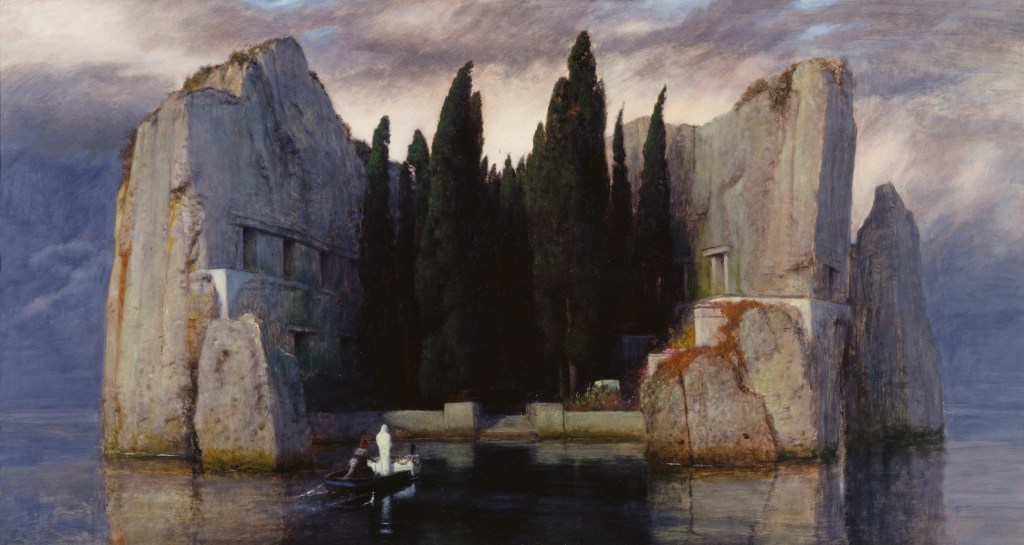
We’re still in Nathan’s record collection at this point, but classical this time in the form of Rachmaninov’s magnificent symphonic poem, The Isle of the Dead. This, I knew from the start, needed to be in the book, together with a reference to Arnold Boecklin’s painting of the same name.
And then we move on to Goblin’s La Chiesa from Michele Soavi’s film of the same name. Dark, portentous Italian symphonic-goth-prog at its absolute finest. (Is that a genre? It is now.) Goblin, at this point in their history, had basically been reduced to bass player Fabio Pignatelli. I don’t know if any session musicians were involved, but he did a great job.
The mood remains similarly dark, as we move towards the climax of the book, with Keith Emerson’s Mater Tenebrarum from Dario Argento’s Inferno – the bass part fits my voice very nicely and I’d dearly love the opportunity to sing it! The playlist then closes in a more reflective mood, with Stelvio Cipriani again and the opening theme to Anonimo Veneziano.
Do bear in mind that some of the films I mention are a bit of a tough watch, and far darker than Venetian Gothic itself. I don’t want anyone to be upset or have sleepless nights!
And, with that in mind, buon ascolto!
(* poliziottesco – a genre of tough Italian crime thrillers, popular in the early 70s. Many of these would be considered incredibly reactionary today, but they are of their time and – as a genre – poliziotteschi are full of interest)
(** giallo – slightly different from its literary equivalent, a giallo film is typically characterised as a thriller but with strong noir elements. It might have occasional supernatural overtones and aspects of the slasher film as well. It’s a difficult genre to pin down. Suffice to say, it’s very Italian and you’ll know one when you see one…)








 Philip Gwynne Jones